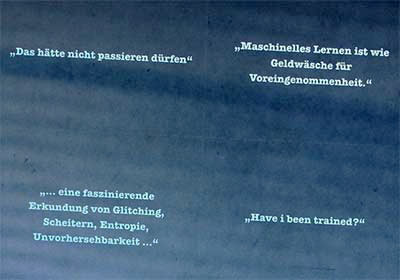
Collection of quotes as a springboard
Two or three things to unlearn: Encounters with A.I. via media art, Workshop performance at the conference "AI in Art Education", University of Koblenz, March 2025
It is difficult to keep track of the effects of one's own use of AI or machine learning. With regard to art education, the question also arises as to what constitutes the creative and critical aspects of learning with and about these technologies.
In the workshop performance, I presented artistic and scientific positions that focus on the discriminatory and exploitative effects of concrete applications, whether in cultural institutions or asylum policy. As part of the workshop performance, the conference participants had the opportunity to choose from a series of puzzling quotes about what they wanted to learn more about: whether through idiosyncratic studies by digital humanities scholars or through playful scenarios in which media artists test hybrid spaces of possibility. These insights into artistic and scientific perspectives convey approaches to agency that offer important impetus for teachers and students alike. Following the short inputs, her task was to formulate references to the living environment of students and to her own art lessons in exchange with other participants.
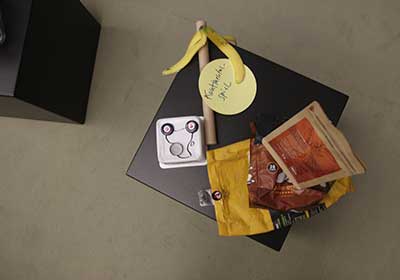
View of the garbage exhibition
Garbage as Material: Global Cycles, Art, and Critique,
Training for educators with Tarfa Bachan, Haus der Kulturen der Welt, Berlin, October 3, 2024
How do people deal with waste? What stories does waste tell about consumption, appreciation and sustainability? In the workshop "Garbage as Material: Global Cycles, Art and Critique" we reflected together on how garbage can be understood not only as a problem, but also as a creative tool. We investigated the cultural, social and environmental implications of waste and asked how waste shapes and mirrors different societies.
In doing so, we looked at garbage as a resource in art, and how artists around the world use garbage as a material to draw attention to ecological and social grievances. Through practical exercises and discussions, art pedagogical methods were tested during the workshop in order to deal differently with garbage/material in the classroom. Based on pieces of garbage we had brought with us, we developed an exhibition that dealt with the production, recycling and disposal of different materials. The aim of the workshop was to provide participants with new perspectives and tools to creatively and critically convey the handling of material resources and their multiple dependencies in the classroom. The training was part of the cooperation between HKW and UdK Berlin within the framework of Schools of Sustainability. Agency instead of powerlessness (2023–24).
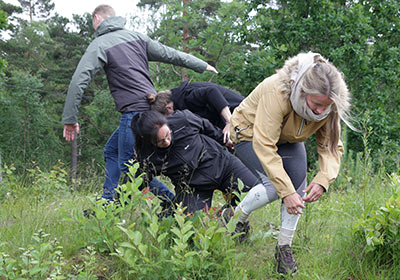
Performance, based on the question of what role (critical) diversity could play in my professional actions
Doing Diversity in the Arts (Institution),
Workshop with Wiebke Trunk as part of "Arts in Action: Doing Diversity", University of Agder, Kristiansand/NOR, June 13/14, 2024
In a pluralized society, academic teachers and learners are faced with the question of how diversity-reflecting, artistic and scientific teaching-learning contexts can be designed. Therefore, with this workshop, we wanted to address questions about social and cultural differences and diversity from an individual and institutional perspective. It is important to us not to understand diversity as a dazzling fantasy concept or an innocent, auspicious practice, but also to deal with more uncomfortable issues such as privilege, discrimination and equality.
At the same time, a serious examination of diverse and pleasurable methods such as montage, performance, installation and materials from art, music and theatre was linked. In this complex environment, our goal was to communicate across differences and to speculate together in artistic form about our own role and practice in the institution.
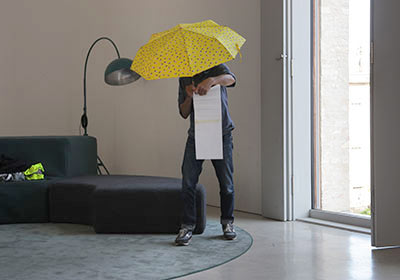
Staging of a collective script "The worst day at school"
"Hej, what is so funny about it?" – Humour and Aesthetic Education
Difference-Reflective Teaching Workshop with Ömer Bayram, Haus Bastian, Centre for Cultural Education, Berlin, April 27, 2024
Based on our own experiences and examples, we looked at the common misunderstandings and conflicts associated with humor in school. These irritations have partly to do with the meeting of different generations, which is why this training focuses on adultism, among other things. Adultism stands for the power imbalance between the generations, which decisively shapes the structures of educational institutions, for example.
However, conceptions of humor also arise from various other social perspectives, through which different ideas of humor and its limits can emerge. In addition to reflecting on one's own humor and an understanding of student humor, theater pedagogical exercises and art pedagogical approaches for transfer into the classroom were tested.
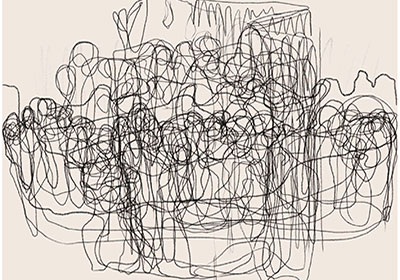
Tarfa Bachan, excerpt from the observations of 7th November 2023
How to communicate the weather to children and young people? From dealing with environmental facts and climate feelings
Training for educators House of World Cultures, Berlin, February 14, 2024
What's so political about the weather? What artistic tactics can support the treatment of the climate crisis in the classroom and the development of visions of the future? This training first addressed the individual relationship of the participants to climate issues. With the help of performative exercises, they talked about their own knowledge and emotions in the face of the climate crisis. In addition, art and theatre pedagogical methods were tested to convey perspectives for action. The aim was to start a conversation based on artistic productions, to become active and to develop possible applications for their own lessons.
The training was designed in the seminar "Conveying climate change in a strengthening way" under the direction of Nanna Lüth and was led by students. It is part of the cooperation between HKW and the UdK Berlin within the framework of Schools of Sustainability. Power to act instead of powerlessness (2023–24).
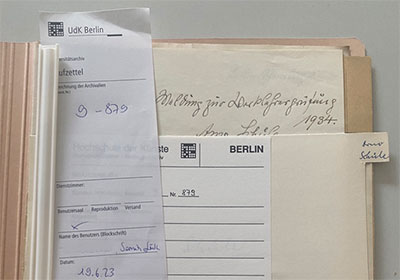
Files from the UdK Archive
Art / Education in National Socialism. Retrospect, continuities, perspectives
Presentation of results Working Group on Culture, Politics and Education, Haus Bastian, Centre for Cultural Education, Berlin, January 24, 2024
Two series for teacher student at the UdK Berlin in the summer 2023 addressed "Art/Education in [and after] National Socialism" and thus continuities of fascist ideologies, personalities or aesthetic practices, gaps in knowledge and post-Nazi perspectives on the school subject of art in Berlin. One reason for this was that there has been no systematic research on the predecessor institution of the Berlin University of the Arts, where it was possible to study art education in the Nazi era. Another impetus was the lack of reappraisal of the Nazi era in art education. In order to encounter both, guests were invited to present their artistic or scientific research. At the same time, students went to the archive of the art academy and researched original documents and followed individual research questions.
Six months later, three of the resulting term papers were presented to the Working Group on Culture, Politics and Education. In this context, Nanna Lüth, Greta Wildhage, Anna-Maria Podlacha and Michelle Marx provided insights into the processes and results of research-based teaching. They talked about (1) the overall concept of the research module, (2) questions of documenting violence and persecution in the context of the exhibition Flashes of Memory. Photography in the Holocaust, (3) Serious research gaps regarding the institutional history of universities during the Nazi era and (4) Prevention of right-wing extremism through aesthetic education.
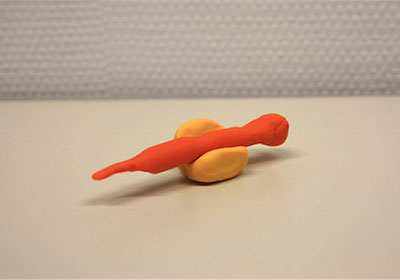
Soldering iron made of plasticine
Becoming Funny. Reflexivity of Difference and Humor in Teaching
Workshop at the Berlin Center for University Teaching (BZHL), October 20, 2023
Do I show my sense of humor in teaching? What reactions do I know, which are likely? What can humor with a difference-reflexive or inclusive claim look like? These are the kinds of questions that this seminar dealt with. This training consisted of the following modules: An exercise to reflect on one's own experiences with humor in teaching (see figure), an input on conceptual foundations and practical examples, a discussion of the strategies of selected comedians and artists, and a transfer phase to collect one's own differential humor projects for teaching. Becoming funny is used here ambiguously: it stands both for the development of one's own humor and - in the sense of becoming strange - for the practice of extraordinary, often minoritized perspectives.
A distinction can also be made between humour as an attitude or personality trait and comedy as an aesthetic or media form. The fact that comedy is often based on surprises shows parallels to artistic processes of shifting and irritating. It is therefore obvious that there is something to be learned for pedagogical practice in artistic projects that use comedy with an agenda critical of normality.
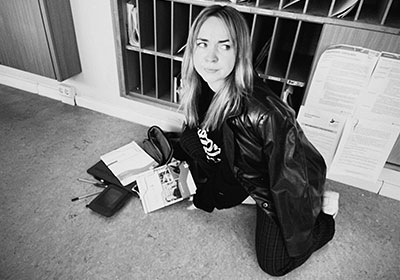
Restaging of the acted mishap in Cindy Sherman´s Untitled Film Still #10 (1978) in the teachers´ room by Alexandra Weiler
Advanced training for teachers, online
Landesinstitut für Pädagogik und Medien, Saarbrücken, 2nd/9th November 2021
Today, corporeality and media action are considered to be closely intertwined. Addressing this relationship in school is therefore both a challenge and an opportunity, because it accompanies students and teachers every day.
The seminar combined short inputs, discussions and practical parts. The decisive factor was that the teachers realised their own photo productions in the week between the two sessions. This step served to update the existing artistic expertise as well as to try out presentation tasks before they were to be introduced into the respective lessons. Finally, we collected suggestions on how media such as photography, audio or video could be used in art lessons.
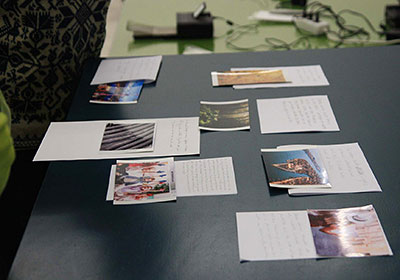
Viewing the photo-text sequences
Workshop
Working Group School and Museum at Haus Bastian, Centre for Cultural Education, Berlin, 4th November 2021
Dana Bagur, Eric Mader Alba and Nanna Lüth were invited to the Working Group School and Museum to give insights into the art didactic seminars "unphotographing stereotypes" and "difference-reflective photo education", which had taken place at the Berlin University of the Arts in 2021. Our aim was to illuminate the concept of the stereotype from different angles. Photodiaries had served as a central medium in the seminars to document this photographic research and subsequently translate unphotographing, i.e. the deconstruction of stereotypes, into didactic ideas.
In the Working Group School and Museum, the theoretical framework and the interim results of the seminars were presented in short inputs. The examples presented, which referred to everyday cultural distinctions in Mexico as well as to nostalgic memory politics between France and Algeria, made it clear that stereotypes are culturally specific and sometimes cannot be understood by outsiders without commentary.
This was followed by an interactive photo-text exercise led by Dana Bagur and Eric Mader Alba, which was realised with mobile phones, portable photo printers and personal pictures brought along. During this playful exercise narratives in the interstices of the different perspectives were developed.
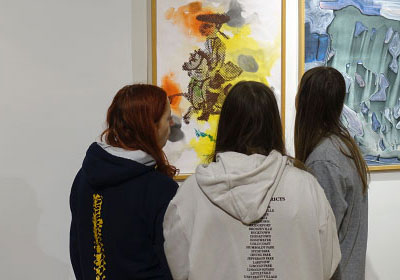
School students in the exhibition‚Music from an Unknown Source' (1996)
Question Higher Orders
Lecture and workshop on the exhibition Sigmar Polke: Music from an
Unknown Source, Romanian-German Cultural Center Brasov in cooperation
with the IFA - Institute for Foreign Cultural Relations, December 2018
The exhibition opened with a lecture on Polke's biography and working
methods.
In a subsequent workshop with pupils and adults, we approached the series
Music from an Unknown Source (1996) by Sigmar Polke in jointly
made-up stories. These were set to music and recorded in several voices.
The focus was on the development and exchange of personal readings of
this medially and visually versatile series.
The teamwork, the mutual listening, the speaking in front of an audience
and the temporary addition to the hanging were perceived as extraordinary,
especially by the participating young people.
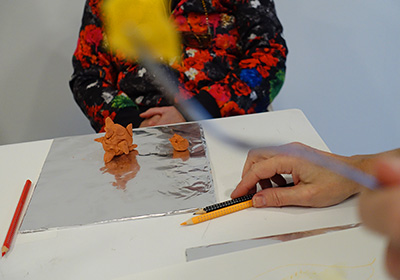
Taste experiment
for the exhibition In the Cut - The Male Body in Feminist Art, Stadtgalerie Saarbrücken, November 17, 2018
This workshop was aimed at people interested in exploring art, physicality and sexuality. After some body and perceptual exercises, the participants* installed objects they had brought with them, which for them were associated with sexuality, at specific places in the exhibition. Along these personal associations we discussed the artistic works.
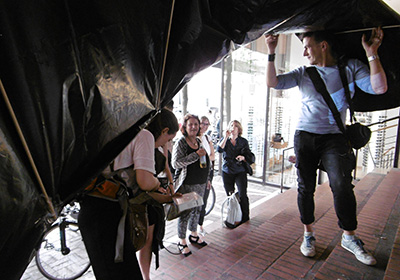
Presentation of a video film at the Aegdiimarkt in Münster
Audiovisual Displacement of Sculptures
Workshop with Katja Böhme as part of the art education weekend
for the Skulptur Projekte Münster 2017, July 2017
This workshop was about approaching some
works of the Skulptur Projekte Münster 2017 in a filmmaking
way.
Katja Böhme and Nanna Lüth had framed the map of Skulptur
Projekte Münster 2017 with envelopes containing the official
information about each work. Numerous works were located within walking
distance; however, more remote works in the vicinity of Münster were
also included in the map.
Students, art teachers and university lecturers participated in the workshop.
We started with a short introduction about our own impressions, the map
and the available video equipment. We were interested in the (in)accessibility
of the works associated with the expansive exhibition format. The participants
were invited to choose one work and to encounter this work with a video
camera. It was agreed that we would meet one hour later at the Aegidiimarkt
in order to project the resulting films there into the urban space with
the help of a portable beamer. Thus, at this meeting point, a medially
supported exchange about what had been experienced and recorded took place.
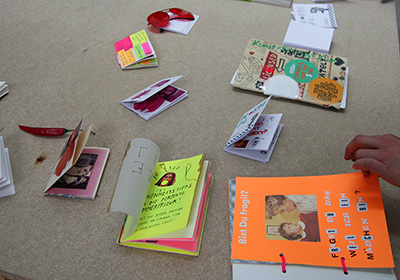
A selection of the zines produced
Module together with Danja Erni in the context of the Network Week of the Bern University of the Arts, June 6 - 8, 2017
In this multi-day module we tested different ways that seem suitable for queering Art Education: a check in à la KontextSchule, mapping/drawing ourselves according to Mikki Muhr, Kate Bornstein's gender outlaw exercise and sharing responsibility with bell hooks. We also danced and collaged and produced a zines in which it all came together.
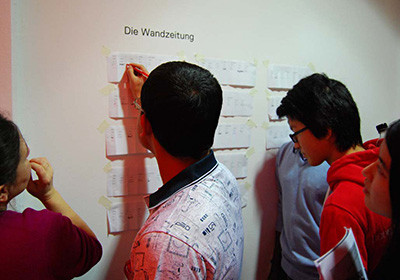
The mural as a place for sentence building exercises
The Mural.
Learning German in the exhibition Claudia Kapp: YouYou. Media Art
Education at the Edith Russ House for Media Art Oldenburg, together with
Doris Mosbach, Jacobs University Bremen, and Jan Blum, January 2012
Learning a new language is facilitated when practiced
in contexts experienced as meaningful. With this in mind, a visit by international
students from Jacobs University Bremen as part of a week of immersive
language learning was framed by a shared coffee and a walk through Oldenburg's
city center.
Claudia Kapp's exhibition YouYou was guided by worksheets that
linked the viewing of the media art productions with language learning
steps. The combination was evaluated by the participants as very positive
and supportive.
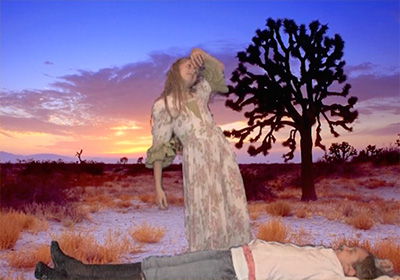
Still from The Wild Western
The Wild Western.
Performance
and video project for children 8 and older and youth. Edith Russ House
for Media Art in cooperation with the Hermannshof Osterscheps and the
Institute for Music, University of Oldenburg, together with Stefanie Oberhoff
and Ludwig Szebel, September 2011
At the Hermannshof in Osterscheps/Edewecht the artists Stefanie Oberhoff
and Nanna Lüth realized the shooting of a "wild western"
. "Wild" in this case meant that we wanted to take the Western
genre apart and create extraordinary situations and images. With the help
of beards, wigs, plastic weapons and matching clothes, the participants,
aged 8 - 18 years, could slip into the roles of cowgirls and cowboys.
Even the horses and dogs present were moved to perform in front of a large
blue screen. The work namely was
done with blue screen technology, which makes it easier to fade in other
backgrounds during editing and thus transport the filmed action to another
time.
In a second step, the video material was
post-edited by students of the Carl-von- Ossietzky University under the
guidance of video editor Ludwig Szebel. The freshly cut and dubbed wild
western was presented and celebrated one week after the last day of shooting
in the presence of many children, young people and adults involved.
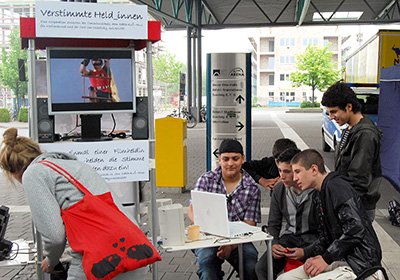
Public action at the train station
Out-of-tune hero*ines.
Multimedia
project and action for Prevention Day. Edith Russ House for Media Art
in cooperation with the Institute for Material Culture-Textile - Media,
University of Oldenburg and the Comenius School Oldenburg, March - June
2011
The linking of popular heroes with masculinity, strength and agency made
them the starting point of this artistic-educational project. In the media
project "Out of tune heroines" the untouchability of such heroic,
in some cases also violent figures should be questioned by a 7th grade
of the Comeniusschule Oldenburg, in a longer crossmedia process.
First, the students designed hero*ine profiles and each thought of a heroine
pose in which they wanted to be photographed. Stereotypical and surprising
sentences were put into the mouths of these heroines by means of speech
bubbles. After that, the students started to dub existing heroine characters
in films. The students viewed various film clips without soundtracks and
selected their favorite ones. This resulted in small groups that wrote
new dialogues corresponding to the lip movements, in which they brought
out the vulnerable, silly or quarrelsome side of film heroines.
The results of these idiosyncratic dubbings were presented at the 16th
German (Violence) Prevention Day at the train station next to the police
information booths. Guests of the prevention day, police officers and
travelers could watch the project results of the class and spontaneously
lend their own voice to heroines at two laptop stations.
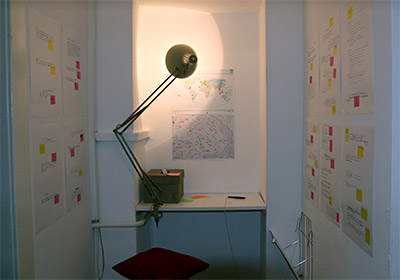
Exhibition situation in the Altes Museum Neukölln
Good memories, bad memories– in Neukölln.
Video and performance project with Barbara Loreck and class 5a of the
Grundschule am Richardplatz in the context of urban memories, Altes Museum
Neukölln, Berlin 2010
This project with pupils of the Richard elementary
school in Neukölln established a connection between the exhibition
urban memories in the "Altes Museum Neukölln" (curator:
Maria Linares) and the Ganghofer Straße neighborhood. The basic
idea was not to address a specific target group and yet to record cultural
and social similarities and differences with the help of an overarching
question.
After two introductory meetings, the students approached about 100 passers-by
in the Richardpassage, asked them about their good and bad memories, and
entered the location of each memory on maps of various ranges. From the
collected memories, those that could be translated into scenes were selected
in a follow-up meeting. The subsequent staging for the video camera offered
the pupils the opportunity to deal with the experiences of adults unknown
to them and to rework them into a video film according to their own ideas.
The insights into the memories collected on site gave them - as later
for the visitors of the exhibition - the chance to learn more about the
Neukölln neighborhood and its inhabitants. n.
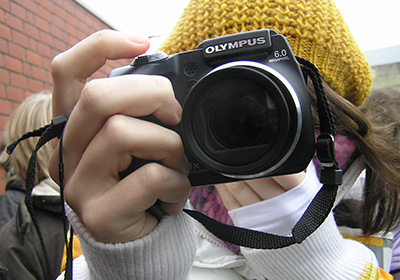
Photography during one of the Oblique Walks
Workshop on the exhibition "textum" by Christof Zwiener (12.12.08-15.02.09), Kunstverein Langenhagen
A tour through the exhibition of Christof Zwiener with its hidden messages inspired unusual walks through Langenhagen: The participants of the workshop Schräge Spaziergänge observed people strolling and crossing public places and thought about how these meeting points could be changed with simple means.
They decided to walk slowly or quickly or to take unusual paths, thus interrupting everyday movement routines. The group's interventions were documented in photographs and drawings and carried back to the exhibition.
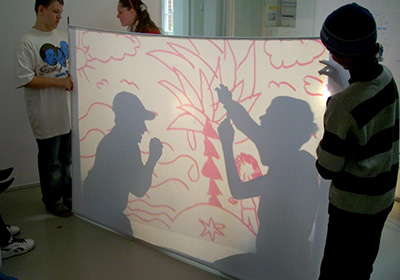
Shadow play on power issues
Shadow and Writing Games for the exhibition Anna Meyer White Cube Sitcom (August 18 - October 5, 2008), together with Steffi Prange, Kunstverein Langenhagen
In the exhibition White Cube Sitcom the Viennese artist Anna Meyer presented a story about power, money and politics from the art world of her hometown on painted plexiglass panels.
For this, the Kunstverein Langenhagen offered workshops in creative writing and shadow play. The participants got to know the picture story by Anna Meyer and developed their own narratives about power, prejudices, competition and rumors.